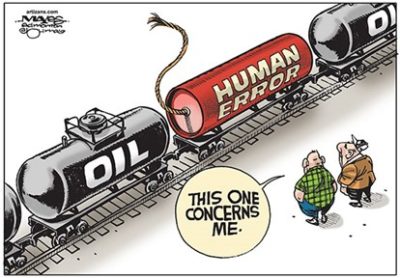
Whenever something goes wrong, we often hear the label ‘human error’ being applied. Within Human Factors, human error is the starting point for an investigation, not the end point. Ok, somebody did something wrong, but why? What was it about the person, the task, the team, and most importantly the organisation that influenced the error?
 The starting point is understanding what the different types of errors are. Errors are unintentional acts and James Reason divided them into three different categories: slips, lapses and mistakes. Slips are when you have the right idea but something interrupts the execution of it and you do the wrong thing (action slip) or when you don’t notice (or misperceive) some information in the environment (perceptual slips). Typos are action slips – you intend to hit one key on the keyboard but you hit a different one while missing the word ‘not’ in a written sentence (For example: removing your credit card when you see the message: ‘please do not remove your card’) is a common type of perceptual slip. Slips tend to happen when we are expert at something and stop having to think about it. This kind of automated mental processing (called schemas) frees up our brain capacity to allow us to concentrate on the other things that are happening around us and is usually very effective and efficient. Think about changing gear in your car – when you first learned to drive you had to think about each step in the process but when you have been driving for a few years you don’t think about it at all anymore. The process is usually very reliable, but these schemas can be prone to being triggered at the wrong time or to go wrong if they are interrupted or there is something unusual about the situation.
Lapses are moments of forgetfulness, for example forgetting a step in a process. Interruptions are a common cause of lapses, particularly for experts. When someone knows exactly what they are doing there is a tendency to think about the next steps. If you are interrupted, it is common to start at those steps that you were last thinking about, and perhaps forget to complete the step before that. Lapses are also very common when you were intending to do something and forget to do it. This is a kind of memory called ‘prospective memory’ – you form an intention to perform an action later, for example to take dinner out of the oven in half an hour, but often you get busy doing other things after forming the intention and forget to do the action at the right time. This is why it’s a good idea to use timers to remind us to take dinner out of the oven instead of relying on our memories!
The final type of error is mistakes. These are different to slips and lapses because for both those types, you know the right thing to do, just for the kinds of reasons described, you don’t do it. Mistakes are errors where you make the wrong decision – you don’t know what the right thing to do is, maybe because you don’t have the relevant or correct information available to you or because you don’t fully understand the situation. You try to do the right thing, but you come to the wrong decision.
Many different things can affect how likely errors are, for example: working in hot or noisy environments, poor lighting, workload that is too high or too low, lack of experience, interruptions, poor communications, fatigue, personal stresses, poorly designed equipment, or missing or incomplete information. Understanding and reducing these factors is one way to reduce error. Automation can also be very successful in reducing errors, for example the interlockings used in signalling are very effective at preventing conflicting routes being set for trains. Human Factors tries to identify these what influences errors and design the work environment and tasks to minimise them, and one of the most important ways of identifying what can be improved is learning from errors that have occurred.